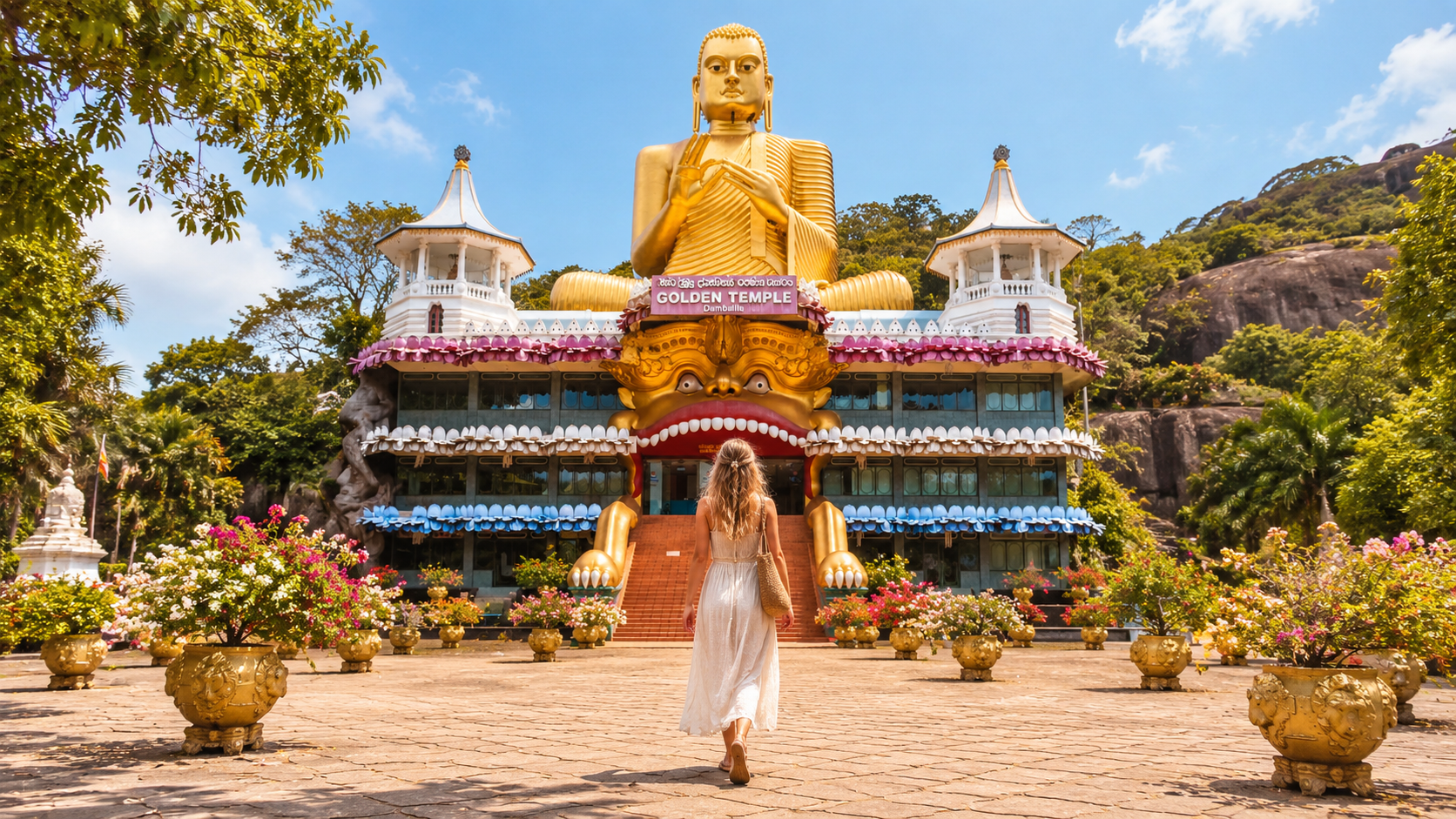
A morning at Dambulla Cave Temple begins with a climb.
Above the busy town of Dambulla, stone steps lead towards a series of ancient caves hidden beneath a huge rock overhang. As you climb higher, the town gradually falls away and views begin to open across the green plains of central Sri Lanka.
Then you step inside.
Painted ceilings follow the curves of the rock, Buddha statues fill the dimly lit chambers and the heat outside gives way to the quieter atmosphere of the caves.
For travellers exploring Sigiriya and Sri Lanka’s Cultural Triangle, this is an easy experience to dedicate a morning to.
Why Spend a Morning at Dambulla Cave Temple?
Morning suits Dambulla particularly well.
The walk to the caves is uphill and partly exposed, so starting before the stronger heat of the day makes the climb more comfortable. It also leaves the rest of your day available for another Cultural Triangle experience.
Dambulla is especially easy to combine with Sigiriya because the two sites sit relatively close to each other.
If Sigiriya is also part of your plans, our 2 Day Sigiriya Itinerary can help you build the wider area into your stay.
Step Inside the Five Cave Shrines
The real reward of a morning at Dambulla Cave Temple comes when you reach the top.
Instead, you move through five separate cave shrines, each shaped by the natural rock and filled with religious art.
Inside you’ll encounter reclining, standing and seated Buddha figures alongside statues of kings and other religious figures.
But look above you too.
Paintings spread across the ceilings and walls, following the irregular curves of the caves rather than sitting on flat surfaces like paintings in a gallery.
The contrast is striking: bright tropical daylight outside, then richly decorated and comparatively dark spaces inside.
Don’t Rush Through the Largest Cave
The second cave, Maharaja Vihara, is the largest of the five and one worth taking time to explore.
Instead of simply moving from statue to statue, step back and look at how the entire space works together.
Figures line the walls while paintings extend overhead, creating a shrine where almost every visible surface contributes to the experience.
Remember That This Is Still a Place of Worship
It is easy to approach Dambulla as another historic attraction.
But people still come here to worship.
You may see flowers being offered, people praying or quiet religious activity taking place beside visitors exploring the caves.
That changes how the temple should be experienced.
Speak quietly inside the shrines, don’t interrupt people who are praying and be thoughtful when taking photographs.
A morning at Dambulla Cave Temple becomes far more meaningful when you experience it as a living religious place rather than simply an ancient monument.
Take in the View Before Walking Down
Before beginning the descent, spend a few minutes outside.
From the elevated temple area, the landscape stretches away across central Sri Lanka.
After spending time inside dark, enclosed caves, stepping back into the open landscape creates a completely different feeling.
This is also a good moment to slow down before heading back down the steps.
You don’t need to immediately rush towards the next attraction.
Continue to Sigiriya After Dambulla
One reason Dambulla works so well in the morning is what you can do afterwards.
Sigiriya is the obvious next stop if you’re exploring the Cultural Triangle.
But don’t make the mistake of trying to race through both places.
Dambulla is about enclosed caves, Buddhist art and religious atmosphere. Sigiriya gives you something completely different: gardens, ruins, engineering and a climb to the remains of an ancient royal citadel.
If you want to understand more before visiting, read our guide to why Sigiriya is called Lion Rock.
Together, the two places reveal very different sides of Sri Lanka’s cultural landscape.
How Much Time Should You Allow?
Give yourself roughly two hours rather than trying to squeeze Dambulla into a quick stop.
That allows time for the climb, the five caves, the views and the walk back down without constantly checking the clock.
Travellers who particularly enjoy Buddhist art, photography or historic places may want longer.
If your itinerary has space, return to your hotel for lunch or a break afterwards rather than immediately adding another climb.
Our guide to things to do in Sigiriya can also help you choose another nearby experience without overloading the day.
Is a Morning at Dambulla Cave Temple Worth It?
Yes, particularly if you’re already staying around Sigiriya, Dambulla or Kandalama.
A morning at Dambulla Cave Temple offers something quite different from the open ruins and dramatic landscapes found elsewhere in the Cultural Triangle.
The experience is quieter.
Climb while the morning is still relatively cool. Take your time inside the caves. Look closely at the painted ceilings. Respect the people who have come to worship.
Then step outside and look across the plains before walking back down.
Sometimes a memorable morning doesn’t need a long itinerary.