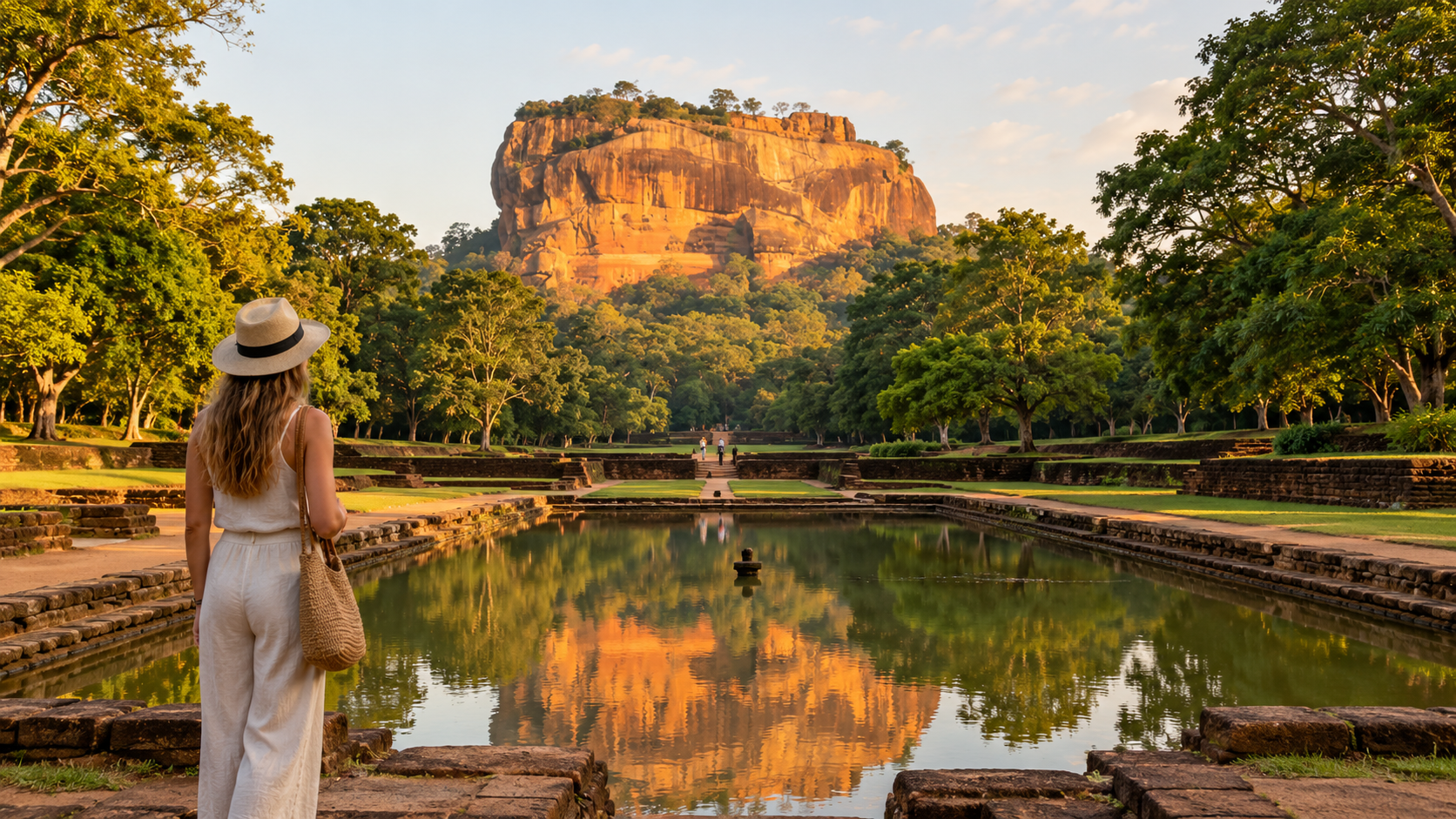
Long before visitors reach the famous staircase leading up Sigiriya Rock, they walk through one of the site’s most remarkable achievements.
The Sigiriya water gardens are a carefully planned landscape of pools, channels, fountains, islands and underground waterways. Developed as part of the royal complex associated with King Kashyapa in the late 5th century, they demonstrate how architecture, landscape design and sophisticated water management came together at ancient Sigiriya.
What makes them especially fascinating is that the system didn’t simply store water. It controlled how water moved through and shaped the gardens.
The Gardens Were Part of a Much Bigger Plan
Sigiriya was more than a palace built on top of a rock.
The wider complex included fortifications, moats, landscaped gardens, buildings and the palace area on the summit. If you want the broader story behind the site, read our guide to Sigiriya Rock, its history and human ingenuity.
On the western side of the rock, the gardens were arranged along a strong east-west axis.
Visitors moved through a highly organised landscape before reaching the more natural-looking boulder gardens and then the terraced gardens climbing towards the rock.
Water played a central role in this progression.
How Did the Sigiriya Water Gardens Get Their Water?
The Sigiriya water gardens were connected to a wider system involving reservoirs, moats, pools, channels and underground conduits.
Water could move through the lower garden system using differences in elevation. Instead of relying on modern mechanical pumps, engineers used gravity and hydraulic pressure.
This hidden network meant the gardens visitors saw above ground were only one part of the engineering.
Fountains Powered by Water Pressure
The fountains are perhaps the best demonstration of how ingenious the system was.
In the fountain garden, long pools and winding channels sit on either side of the central pathway.
Water travelling through enclosed underground conduits created pressure. When it reached perforated limestone fountain plates, that pressure forced water upwards through small openings.
There was no electricity involved.
Remarkably, these ancient fountains can still become active when conditions provide sufficient water, particularly during rainy periods.
It is one reason the Sigiriya water gardens are much more than decorative ruins. Parts of the original engineering principles can still be observed today.
Three Different Water Garden Areas
The gardens were not designed as one enormous pool.
The first principal water garden incorporated an island surrounded by water and connected by causeways.
Farther east, the second area contains the long pools and fountains. Raised islands beside this section once supported buildings often interpreted as pavilions or summer palaces.
The third water garden sits at a higher level and includes a large octagonal pool.
The increasingly irregular landscape helps create a transition towards Sigiriya’s boulder gardens, where pathways weave between enormous natural rocks.
For another look at the landscape surrounding the fortress, explore the secret life of Sigiriya’s lakes.
What About Water on Top of Sigiriya?
Water management wasn’t limited to ground level.
The summit also contains pools and cisterns associated with collecting and storing rainwater. The natural slope of the summit helped direct water towards collection areas, while drainage channels controlled runoff.
This is important because descriptions of Sigiriya sometimes oversimplify the system by suggesting water was simply pumped all the way from the gardens to the summit.
The evidence instead points to multiple water-management strategies, including rainwater collection on the rock itself.
If you’re planning to see the entire complex rather than only reading about it, our 2 day Sigiriya itinerary can help you give the area enough time.
Look at the Gardens Before Looking Up
Many visitors enter Sigiriya already focused on reaching the summit.
That makes it easy to walk quickly through the gardens.
Slow down instead.
Look at how the pools line up with the central path. Notice the channels running between different areas. Find the limestone fountain stones and imagine water emerging from them. Watch how the formal symmetry gradually gives way to rocks and terraces as you approach the fortress.
Understanding this landscape changes the experience of Sigiriya.
For travellers deciding where to base themselves while exploring the area, our network guide to where to stay near Sigiriya also compares Sigiriya, Dambulla and Kandalama.
More Than an Ancient Garden
The Sigiriya water gardens reveal a side of the ancient city that can easily be overshadowed by the rock fortress above.
Their interconnected pools, underground conduits, fountains, moats and carefully planned levels show that Sigiriya’s builders understood not only architecture but also how water could be stored, directed and used to shape a landscape.
More than 1,500 years later, the surviving system still helps visitors understand the sophistication behind the royal complex.
So when you visit Sigiriya, don’t rush straight towards the stairs.
Some of the site’s most impressive engineering is already beneath your feet.