Sigiriya Boulder Gardens: How Were They Designed?
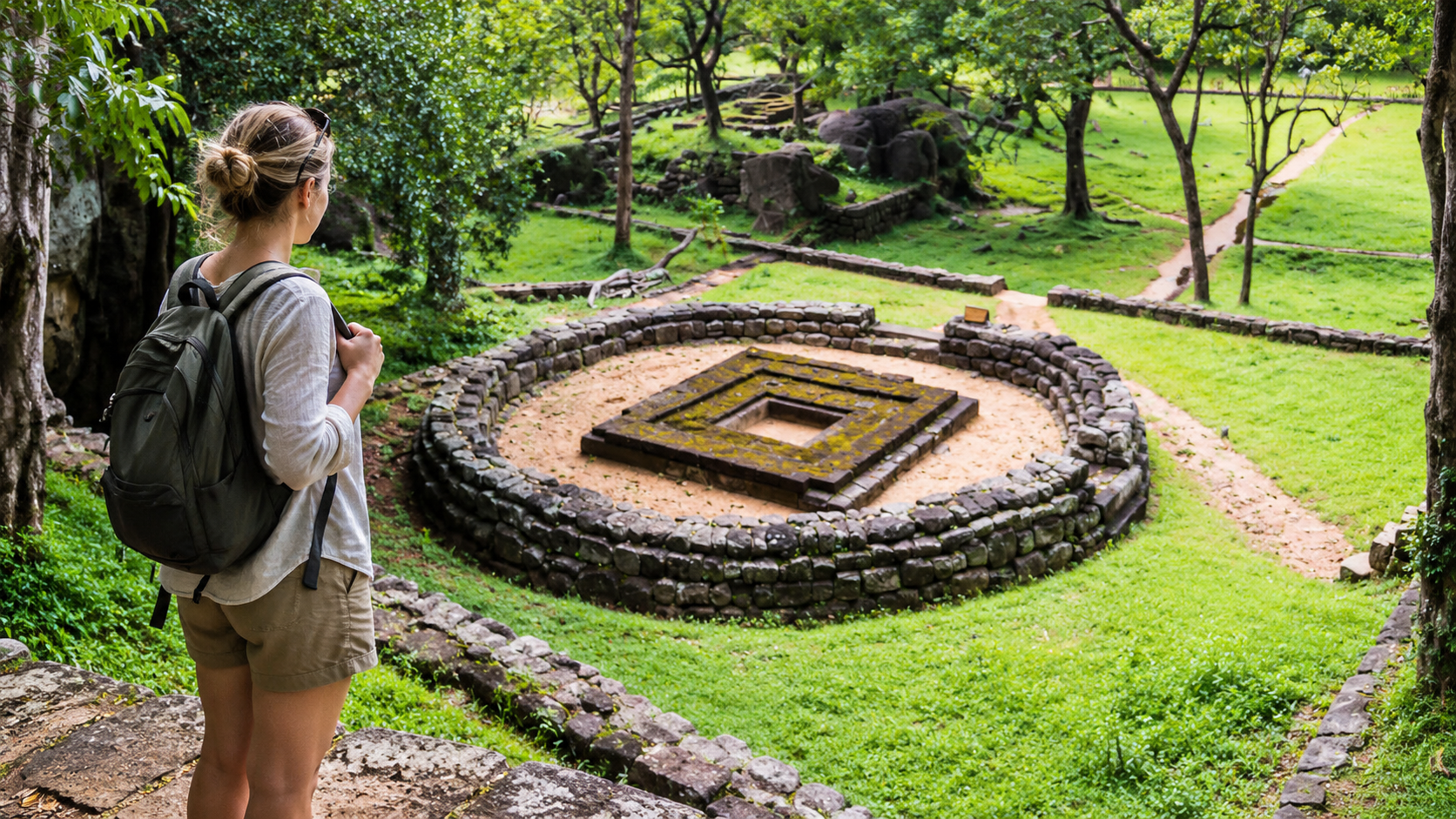
The Sigiriya Boulder Gardens form an important part of the ancient landscape surrounding Lion Rock. Instead of clearing the natural boulders to create a perfectly ordered garden, the designers worked around, between and on top of them.
Winding paths pass beneath rock arches, buildings once stood on boulder surfaces, caves were incorporated into the landscape and even seats and water cisterns were cut directly into stone.
The result is very different from the geometric water gardens nearby.
Where Are the Sigiriya Boulder Gardens?
The Sigiriya Boulder Gardens lie between the formal water gardens and the terraced gardens that rise towards the main rock.
Visitors approaching from the west first encounter carefully organised water gardens with pools, channels and strong symmetry. Moving closer to Lion Rock, the landscape becomes increasingly irregular as pathways enter an area dominated by huge natural boulders.
Beyond them, the terraced gardens begin climbing towards the rock itself.
For a closer look at the first of these areas, read about the Sigiriya Water Gardens.
Were the Boulders Placed There?
No. The huge rocks are natural features of the landscape.
What makes the Sigiriya Boulder Gardens remarkable is how ancient builders incorporated these existing formations into the architecture.
Rather than forcing every part of the site into the same geometric pattern, designers allowed the shapes and positions of the boulders to influence pathways and structures.
How Were Buildings Added to the Boulders?
Many boulders still contain clues showing that structures once stood against or on top of them.
Rows of holes and cut marks can be seen in the rock surfaces. Archaeologists interpret many of these as fittings or foundations associated with brick walls, timber beams and other architectural elements.
Where there is now an exposed boulder, there may once have been a pavilion or another structure integrated with the stone.
What Is the Audience Hall Rock?
One of the best-known features of the Sigiriya Boulder Gardens is commonly called the Audience Hall Rock.
The upper surface of a large boulder was levelled and polished to create a platform.
A long seat was carved directly from the rock itself rather than being added as a separate piece of furniture. Steps were also cut into the stone to provide access.
It is traditionally interpreted as an audience hall, although identifying the exact function of every surviving structure at Sigiriya is difficult.
What Is Cistern Rock?
Another important feature is known as Cistern Rock.
A large water-holding basin was cut into the top of the boulder.
Water management appears throughout Sigiriya, from the symmetrical pools and fountains of the lower gardens to reservoirs and cisterns associated with other parts of the complex.
Were the Boulder Gardens Only Used by King Kashyapa?
No, and this is an important part of Sigiriya’s history.
The landscape around the rock was used before King Kashyapa I established his royal capital here in the fifth century CE.
During the Kashyapan period, the landscape was transformed on a much larger scale as part of the royal city.
This means the Sigiriya Boulder Gardens preserve several historical layers rather than representing one completely new landscape created at a single moment.
To understand what happened to the site after the royal period, explore what happened to Sigiriya after King Kashyapa.
How Do the Boulder Gardens Lead Towards Lion Rock?
The gardens are not simply an isolated collection of rocks.
They help form the approach towards the main citadel.
As visitors move through the boulders, the terrain gradually begins to rise. The route eventually connects with the terraced gardens, where retaining walls and stairways climb around the base of Lion Rock.
The journey therefore changes from ordered water landscape to irregular boulder landscape and finally to ascending terraces.
For travellers deciding how Sigiriya fits into a wider Cultural Triangle trip, where to stay near Sigiriya also explains the differences between Sigiriya, Dambulla and Kandalama.
Conclusion
The Sigiriya Boulder Gardens show that the ancient designers of Sigiriya did not simply reshape the entire landscape to suit a rigid architectural plan.
Natural boulders became foundations for buildings, surfaces for carved seats, locations for cisterns and walls around winding pathways. Older rock shelters were incorporated into a landscape that later became part of King Kashyapa’s extraordinary royal complex.
That relationship between architecture and natural terrain is what makes the Sigiriya Boulder Gardens one of the most distinctive parts of Lion Rock.