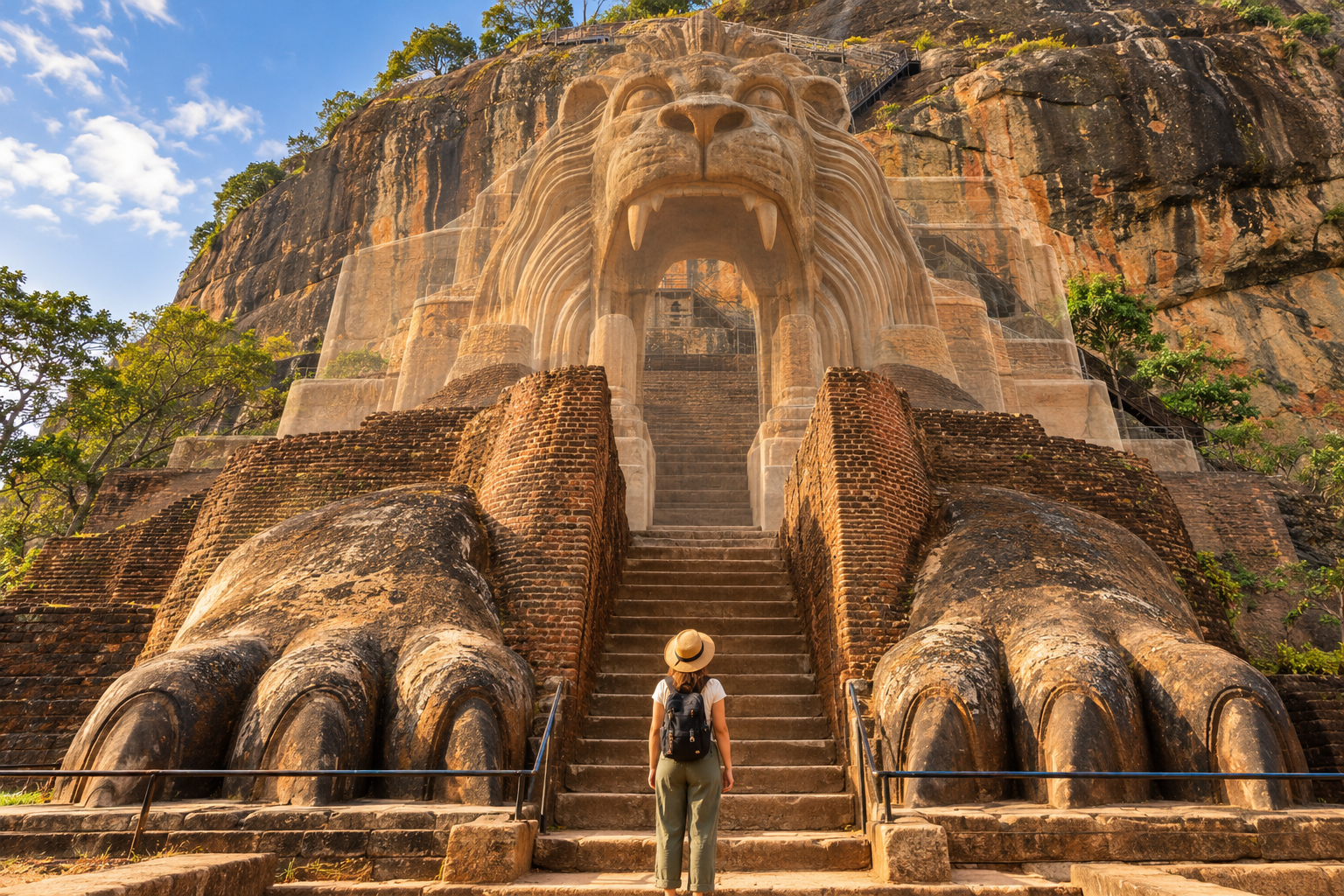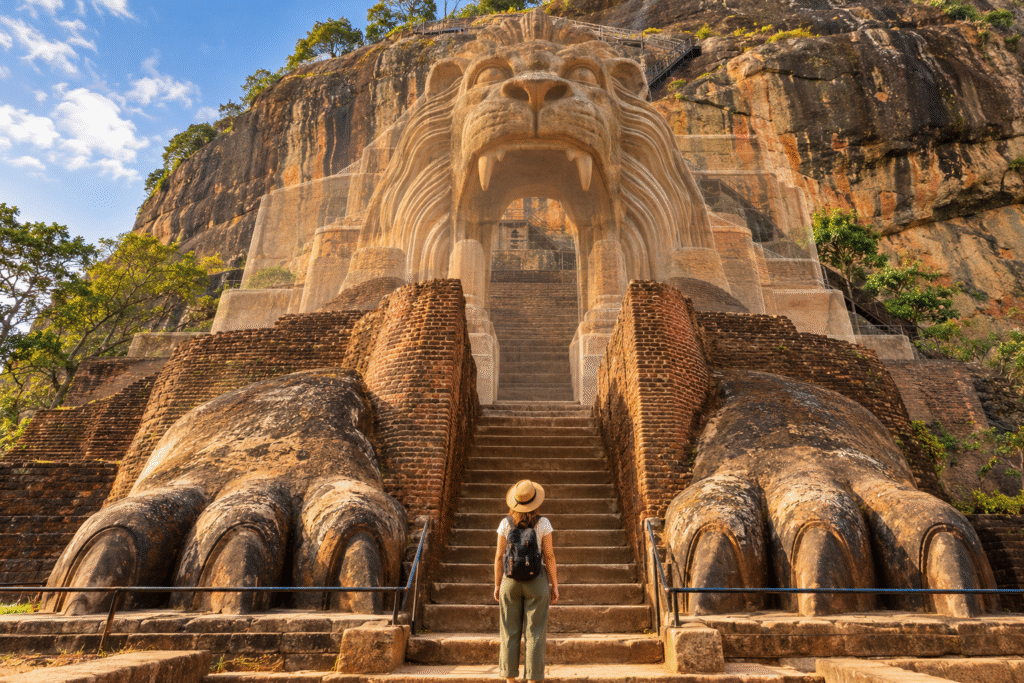
Rising almost vertically from the green plains of central Sri Lanka, Sigiriya is one of those places that seems to have been given the perfect name: Lion Rock.
But there is something many first-time visitors don’t realise.
Sigiriya isn’t called Lion Rock because the natural rock formation looks like a lion.
The real explanation appears partway through the climb.
What Does the Name Sigiriya Mean?
The name Sigiriya is traditionally connected with the idea of a lion rock or lion mountain.
This wasn’t simply a modern tourism nickname created because the site needed a memorable English name.
The lion was physically represented in the architecture of the ancient complex.
Today, Sigiriya is the name used for the archaeological site and surrounding area, while Lion Rock is the widely recognised English description.
Did Visitors Actually Walk Through the Lion?
The ancient entrance is generally understood as a monumental lion gateway through which the route towards the summit continued.
That means approaching the upper section of Sigiriya would have felt very different 1,500 years ago.
Today, visitors see the giant paws and then continue towards modern stairways leading higher.
In the ancient complex, the architectural effect would have been much more dramatic.
You wouldn’t simply stand beside a lion statue.
You would approach the enormous creature as part of your ascent towards the royal complex.
What Happened to the Rest of the Lion?
Most of the original lion structure has disappeared.
What remains recognisable today are the enormous paws beside the staircase.
This is important when looking at modern drawings or digital reconstructions of ancient Sigiriya.
Images showing a complete giant lion are interpretations of how the structure may have appeared. They should not be treated as exact records of its original appearance.
The surviving remains allow us to understand its scale and general concept, but details such as the precise appearance of the head, body and decorative elements cannot be known with complete certainty.
In some ways, this makes standing at the Lion Terrace even more interesting.
The paws give you enough information to imagine the scale without giving you the entire answer.
Who Built Sigiriya’s Lion Gate?
The major royal development of Sigiriya is associated with King Kashyapa I, also written Kassapa, who ruled during the fifth century CE.
During this period, Sigiriya became a royal centre built around the enormous natural rock.
The complex included landscaped gardens, water systems, paintings, defensive features, monumental architecture and structures on the summit.
However, Sigiriya’s story did not begin with Kashyapa.
The surrounding caves and archaeological landscape have earlier associations with Buddhist monastic activity.
This distinction matters.
It means Sigiriya shouldn’t be understood simply as an empty rock that suddenly became a palace.
The landscape already had a history before its dramatic transformation during the royal period.
Was Sigiriya Only a Fortress?
Sigiriya is frequently described as the Sigiriya Rock Fortress.
Look beyond the rock and you’ll find:
- Formal gardens
- Pools and water features
- Fountains and channels
- Boulder gardens
- Terraces
- Paintings
- The Mirror Wall
- Monumental stairways
- Summit structures
- The Lion Gate
Together, these features suggest something much more complex than a defensive stronghold.
Sigiriya was also a carefully designed royal landscape.
The way a visitor moved through that landscape was part of the experience.
Then Come the Famous Sigiriya Frescoes
Higher on the rock are the surviving Sigiriya frescoes.
These paintings of female figures are among the site’s most recognisable artistic remains.
Exactly who the figures represent has been debated.
Different interpretations have connected them with celestial figures, members of a royal court and other possibilities.
Because these interpretations aren’t all equally certain, it’s better to approach the paintings without expecting one simple explanation.
What is clear is that painting formed an important part of ancient Sigiriya’s visual experience.
The surviving figures are also only a fraction of what appears to have once existed.
Finally, You Reach the Lion Terrace
After all of that, you arrive at the paws.
This sequence matters.
Gardens → boulders → paintings → Mirror Wall → lion → summit.
The Lion Gate wasn’t positioned randomly.
It appeared close to the final ascent towards the summit.
That makes it feel almost like the climax of the architectural journey.
By the time an ancient visitor reached this point, the site had already revealed itself gradually.
Then the enormous lion marked the entrance to the next level.
Why Sigiriya Is More Than the Lion
The lion may explain the name, but it shouldn’t become the only thing you notice.
One of the pleasures of visiting Sigiriya is discovering how many different layers exist within a relatively compact area.
History.
Architecture.
Art.
Landscape design.
Hydraulic engineering.
Royal symbolism.
Buddhist history.
And the natural environment surrounding the rock.
That’s also why staying nearby can be worthwhile rather than treating Sigiriya as a rushed stop between two other destinations.
If you’re planning an overnight visit, our guide to hotels in Sigiriya explains the main areas to consider, including Sigiriya Village, Kimbissa and nearby Dambulla.
Staying in the area gives you more freedom to explore the site without immediately continuing on another long transfer.